
Horseshoe Crab Monitoring

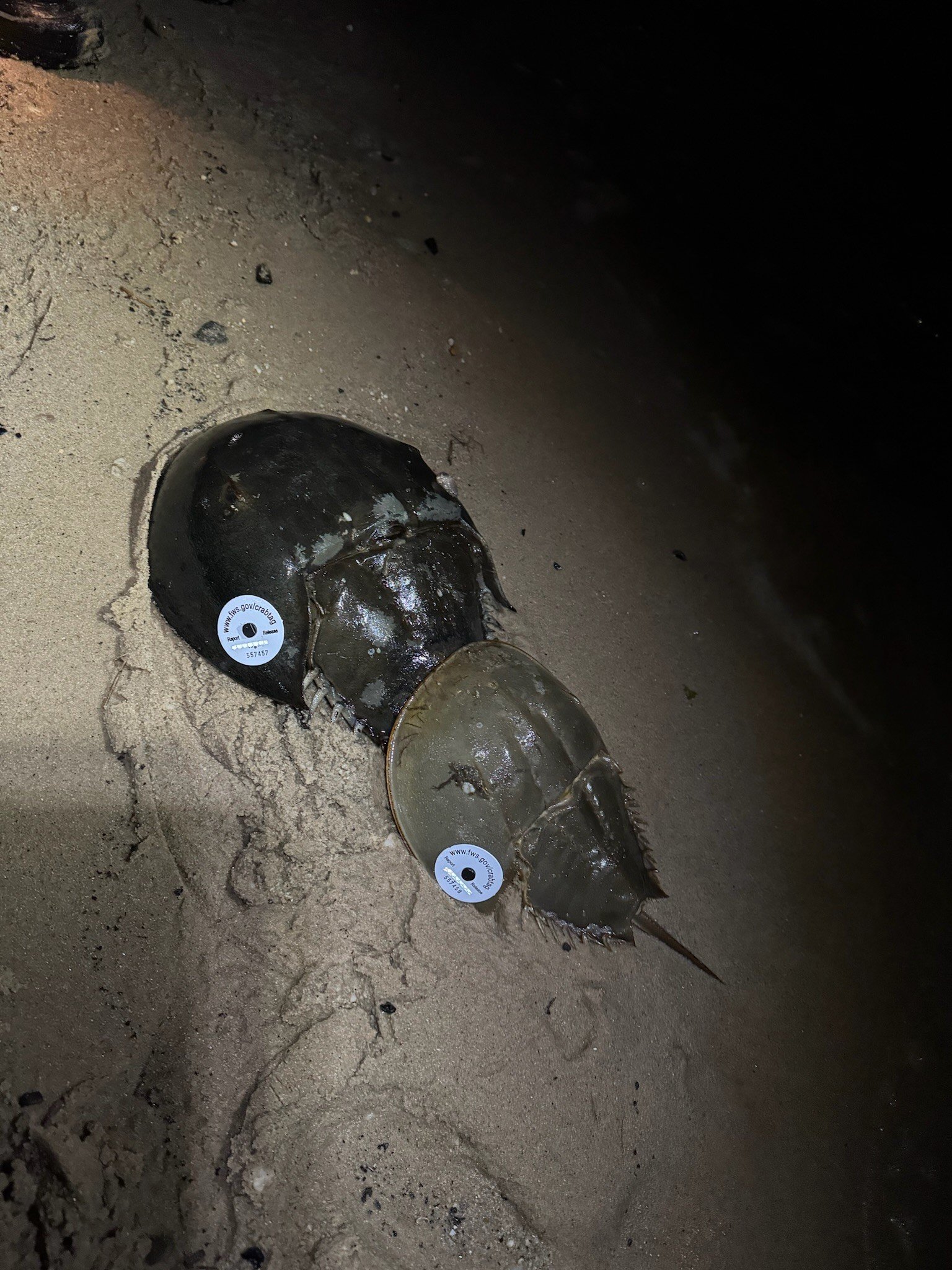
Horseshoe crab populations exist all along the Atlantic coast. Although there has been some variability in recovery of their populations, they have been declining in New York waters. CSHH is collaborating with other organizations to monitor local horseshoe crab populations and track migration patterns to support conservation management of this ancient species.
Horseshoe crabs have survived five mass extinction events and are essentially living fossils, as they have remained relatively unchanged for nearly 445 million years! As a keystone species, they are vital to maintaining the health and balance of the local ecosystem. Their eggs are an important food source for shorebirds such as the endangered red knot, which relies on them during migration to Arctic breeding grounds.
For decades, horseshoe crabs have been overharvested. They have been used as bait for whelk and eel fisheries, and their blood is used in the pharmaceutical industry as a purification agent for vaccines and other medical devices. (Their blood is copper-based, giving it a distinct blue color.)
CSHH has established a monitoring site in Hempstead Harbor as part of the New York Horseshoe Crab Monitoring Network, led by New York State Department of Environmental Conservation (NYSDEC), Cornell Cooperative Extension of Suffolk, and Stony Brook School of Marine and Atmospheric Sciences. Monitoring is conducted across the New York Marine District, which includes all of Long Island, Fisher’s Island, and parts of New York City during full and new moon cycles through May and June (horseshoe crab mating season). Horseshoe crabs are first counted and then tagged using US Fish and Wildlife tags, providing information on the scope of horseshoe crab populations in New York waters and as well as migratory patterns.
Harvesting of horseshoe crabs in New York State is currently allowed under permits issued by the NYSDEC. However, under the New York Horseshoe Crab Protection Act that was passed in 2025, all harvesting of horseshoe crabs, whether used for bait or biomedical purposes, will be phased out by January 2029. This legislation was a hard-won victory for all who have been working toward recovery of horseshoe crab populations.


Nearly 40 Years of CSHH
The Coalition to Save Hempstead Harbor has been working tirelessly to protect and restore our harbor and surrounding communities since our founding in 1986. In celebration of our 40th anniversary, we look back at what harbor conditions used to be, how they’ve changed for the better, and we look forward to doing the critical work that will protect the harbor’s future.
Thank you to the talented Patrick Wright, Katie Taber, and Allen Moore, along with CSHH’s own Charlie Weinstein, for creating this incredible video. Original music soundtrack created and donated by Dave Diamond.